7 Everyday Signs to Build Strength After 50 (No Gym Needed)
As we get older, strength tends to fade faster than muscle. Here are 7 everyday signs, a 30-second chair check, and how to start with no gym.
 The Prime Decades, presented by Theo (AI host)Published 6 min read
In short
As we get older, strength tends to fade faster than muscle, and you often notice it first in ordinary moments: getting out of a chair, climbing the stairs, carrying the shopping in. The good news is that strength responds to training at any age. You don't need a gym. A sturdy chair, your stairs and two shopping bags, twice a week, are enough to start.
Strength fades faster than muscle
Many of us picture aging muscle as shrinking muscle. But when researchers pulled together the studies on this, they found a bigger change. In studies that measured both, strength dropped two to five times faster than muscle mass (Mitchell and colleagues, 2012).
One study followed nearly 1,900 adults in their seventies for three years. Their leg strength fell about three times faster than their leg muscle. And keeping muscle didn't stop the strength from fading.
These numbers come mostly from people in their seventies, so they're not a forecast for you at 50. But they explain why strength, not size, is the thing to keep. And here's the good part: strength responds to training at any age.
7 everyday signs your body needs more strength
None of these is a diagnosis. Think of them as everyday nudges.
- You push off with your hands to get out of a chair. When your hands start doing the work, it's worth noticing.
- Stairs feel harder than they used to. And you reach for the rail more often.
- Jars, heavy doors and shopping bags take more effort. Grip is one of the simplest ways researchers measure strength. In one huge study of nearly 140,000 adults aged 35 to 70, a weaker grip was linked with a higher risk of death over about four years, and it predicted that better than blood pressure did. It's a marker: the study can't show that grip itself is the cause.
- Getting down to the floor, and back up, has become a project.
- You wobble when you put on a sock or a shoe standing up.
- Carrying the shopping in from the car leaves you more tired than it used to.
- You can't remember the last time your muscles really worked. You're not alone. Only about one in three adults in the United States say they do enough muscle-strengthening activity.
If one or two of these sound familiar, it's not a verdict. It's a starting point.
Try the 30-second chair check
Here's a simple check based on a test the US Centers for Disease Control and Prevention (CDC) gives health professionals. You need a sturdy chair with no armrests, and a timer.
- For safety, push the chair against a wall so it can't slide.
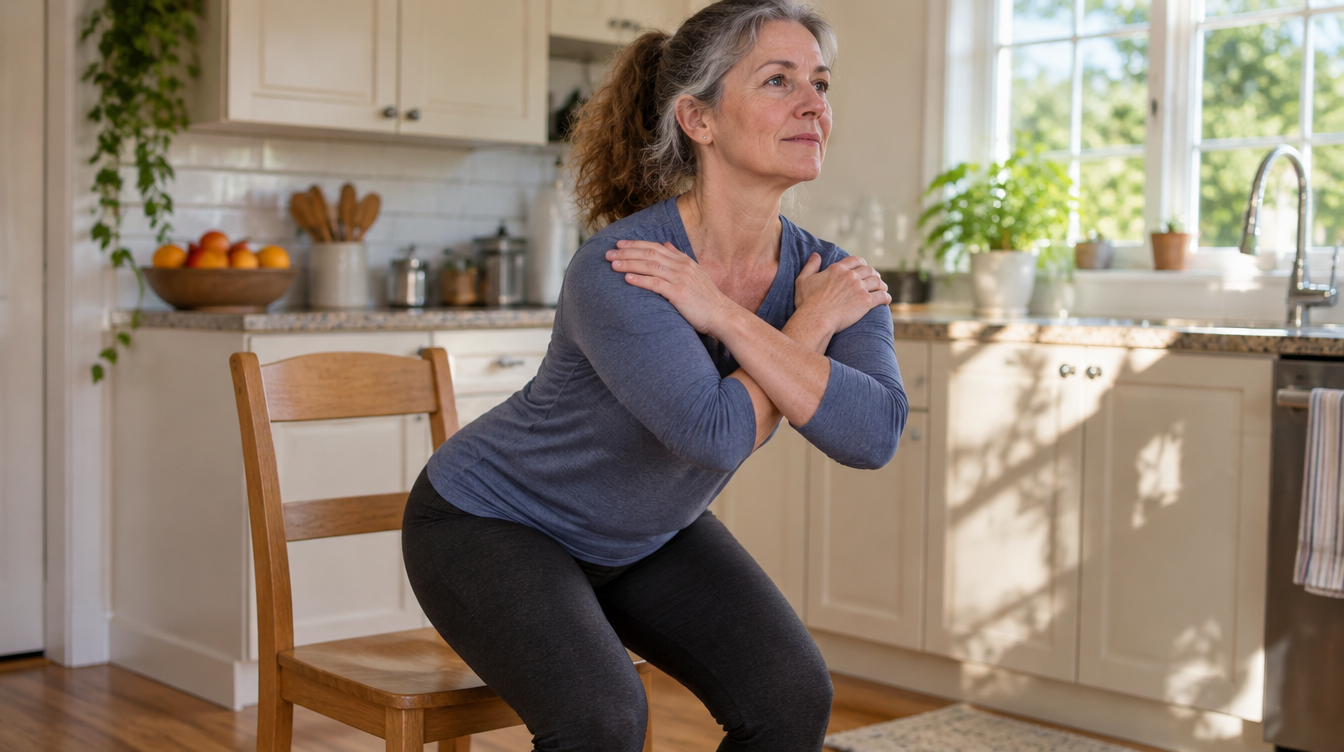
- Sit in the middle of the chair, feet flat on the floor, arms crossed over your chest.
- For 30 seconds, stand all the way up and sit back down, as many times as you can.
- Count your full stands. If you need your hands to get up, the CDC counts that as zero.
For people aged 60 to 64, the CDC chart puts fewer than 14 stands for men, or fewer than 12 for women, below average. The chart starts at 60, so if you're younger, write down your score and use it to track yourself.
It's a simple check, not a diagnosis. A below-average score is a sign your legs could use some strength work, and that's something you can improve. If your balance is a worry, have someone nearby, and stop if you feel pain or dizziness. If your score worries you, or you've had falls, talk to your doctor or a physiotherapist.
What strength work can do
- Strength rises at any age. A review of 47 studies, with more than 1,000 adults aged 50 to 92, found that structured strength programs raised strength by about a quarter to a third. The one thing linked with bigger gains was how hard people worked. Not their age.
- Fewer falls. A Cochrane review of 108 trials, with more than 23,000 older adults, found that exercise reduced the rate of falls by almost a quarter. Balance and everyday-movement exercises did about as well on their own.
- A link with long-term health. A review of 16 long-term studies linked muscle-strengthening activities with a lower risk of heart and circulation disease, diabetes, cancer and death from any cause. For most of these, the link was strongest at about 30 to 60 minutes a week. More wasn't clearly better.
Those 16 studies were observational, so they show a link, not proof. Still, 30 to 60 minutes a week is a very reachable number.
How to start without a gym
In its 2020 guidelines, the World Health Organization recommends muscle-strengthening activities on two or more days a week. And it says all physical activity counts. Your home already has what you need.
In one trial with older adults who had fallen before, people learned to build strength and balance into daily life: bending at the knees instead of the waist, standing up from a chair, taking the stairs, rising onto their toes. Their rate of falls was about 30 percent lower than in a group doing gentle exercise.
Here's an easy way to start. Twice a week, pick three moves:
- Chair stands. Stand up from a chair and sit back down, slowly.
- The bottom stair. Step up and down your bottom stair, holding the rail.
- Two bags. Carry two shopping bags, one in each hand, around the house.
Start with what feels easy, then add a few more each week. One honest note: a review of small trials found that home exercise programs done without supervision, on average, did little for leg strength and function. The bigger gains in the research came with more effort. So keep it a little challenging, and keep going.
Start easy, and check with your doctor if you're new to exercise or have a health condition. And if pain lasts or is severe, see a doctor.
Small things. Every day. For decades.
Your turn
How many chair stands did you get in 30 seconds?
Tell us in the comments under the video on Instagram or TikTok.
Quick answers
How do I know if I need more strength after 50?
Everyday moments are the best clues: using your hands to get out of a chair, reaching for the stair rail more often, or finding the shopping bags tiring. None of these is a diagnosis, but they're a good nudge to start some strength work.
Can you build strength after 50 without a gym?
You can start at home. The WHO recommends muscle-strengthening activities on two or more days a week and says all physical activity counts. Chair stands, step-ups on your bottom stair and carrying shopping bags are an easy start, as long as you keep it a little challenging.
What is the 30-second chair stand test?
It's a check based on a CDC test: arms crossed, you stand up and sit down as many times as you can in 30 seconds. For ages 60 to 64, fewer than 14 stands for men or 12 for women is below average. It's a simple check, not a diagnosis.
How much strength work a week is enough?
The WHO recommends muscle-strengthening activities on two or more days a week. In a review of 16 long-term studies, the link with lower risk was strongest at about 30 to 60 minutes a week, and more wasn't clearly better.
Sources
- Mitchell WK, Williams J, Atherton P, Larvin M, Lund J, Narici M. Sarcopenia, dynapenia, and the impact of advancing age on human skeletal muscle size and strength; a quantitative review. Frontiers in Physiology, 2012.
- Goodpaster BH et al. The loss of skeletal muscle strength, mass, and quality in older adults: the Health, Aging and Body Composition Study. Journals of Gerontology Series A, 2006.
- Leong DP et al. Prognostic value of grip strength: findings from the Prospective Urban Rural Epidemiology (PURE) study. The Lancet, 2015.
- Office of Disease Prevention and Health Promotion. Healthy People 2030, objective PA-04: Increase the proportion of adults who do enough muscle-strengthening activity (CDC National Health Interview Survey data).
- Centers for Disease Control and Prevention. STEADI Assessment: 30-Second Chair Stand, 2017.
- Peterson MD, Rhea MR, Sen A, Gordon PM. Resistance exercise for muscular strength in older adults: a meta-analysis. Ageing Research Reviews, 2010.
- Sherrington C et al. Exercise for preventing falls in older people living in the community. Cochrane Database of Systematic Reviews, 2019.
- Momma H, Kawakami R, Honda T, Sawada SS. Muscle-strengthening activities are associated with lower risk and mortality in major non-communicable diseases: a systematic review and meta-analysis of cohort studies. British Journal of Sports Medicine, 2022.
- Bull FC et al. World Health Organization 2020 guidelines on physical activity and sedentary behaviour. British Journal of Sports Medicine, 2020.
- Clemson L et al. Integration of balance and strength training into daily life activity to reduce rate of falls in older people (the LiFE study): randomised parallel trial. BMJ, 2012.
- Liang IJ et al. The effectiveness of unsupervised home-based exercise for improving lower extremity physical function in older adults in Western and Eastern cultures: a systematic review and meta-analysis. BMC Geriatrics, 2024.
General education, not medical advice. Theo is an AI host created by The Prime Decades. Read our medical disclaimer.